
Union County Projected Versus Actual Release
A projected date is an estimate or computed date based on the sentence and rules that apply at that point. An actual release date records when custody ended. Georgia records may instead use maximum release date, tentative parole month, or release date. Those labels are not interchangeable. A maximum date can describe the end of a sentence, while a tentative parole month reflects possible Board action before that point.
Pretrial detention works differently. Someone awaiting a Union County court decision may leave after bond is posted, a hold clears, charges are dismissed, or a judge changes the order. Until then, there may be no scheduled date. A county sentence can have a computed end, but jail staff and the sentencing order remain the sources.
Find a Union County Inmate Release Date
Identify the custody system first. A person at Union County Jail follows local jail and court records. Someone at Colwell Probation Detention Center or another state facility follows GDC, DCS, and Parole Board records. GDC supports searches by ID, case number, name, demographic filters, offense, conviction county, and most recent institution.
- Confirm the last facility and whether the person is pretrial or sentenced.
- For state custody, open the GDC offender query and use a GDC ID when possible.
- Compare identity, conviction county, offense, sentence, status, and institution.
- Record the exact date-field label shown.
- For local custody, ask the jail for the computed date and compare the court order.
- Check another agency's hold before treating the date as community release.
The Union County released-inmate search gives the full jail and court route for someone who has already left local custody.
Georgia Credits and Union Release Dates
Georgia's state-prison earned-time and performance-credit framework is addressed by O.C.G.A. 42-5-101. Credits may affect an administrative date, but the statute alone cannot calculate one person's release. Sentence type, exclusions, conduct, recalculation, and parole action all matter. The live GDC and Parole Board record is the safer source.
For a Union County Jail sentence, O.C.G.A. 42-4-7 provides a county good-conduct framework. The actual computation still comes from the jail and court order. Credit for time already served may affect the remaining term. No Union County weekend or holiday release rule was found, so no early-release practice should be assumed.
Georgia's serious violent felony provisions in O.C.G.A. 17-10-6.1 impose service restrictions for covered offenses. The research does not support saying every Georgia prisoner serves exactly 85 percent. The offense, sentence, statute, and official record control.
Why Union County Release Dates Change
A date can move for reasons inside or outside the original sentence calculation. Some factors change the computed end. Others prevent community release even when the local term is complete. The distinction between delay and transfer is critical.
| Factor | Possible effect | Source |
|---|---|---|
| Credit recalculation | Moves an administrative date | GDC or jail |
| Discipline | May affect credit | Custody agency |
| Court order | Changes sentence authority | Court docket |
| Parole action | Grant, denial, deferral, rescission | Parole Board |
| Another hold | Continues custody or causes transfer | Jail and receiving agency |
| Federal or ICE matter | Moves custody to another system | BOP, USMS, or ICE |
A local release entry marked transfer is not release into the community.
Confirm the Union County Release Date
Use two sources whenever possible. For county custody, pair the jail event with the court order. For state custody, pair GDC status and date fields with parole information when parole applies. Federal custody uses BOP. ICE custody belongs in the ICE locator, while a USMS hold often requires a federal case or agency contact.
VINELink Release Check can send a custody-change alert when the agency and record participate. It is a notification layer, not a permanent discharge archive. A missing result may mean a spelling issue, another system, an aged record, or no participating feed.
GDC records may show current status, last facility, conviction county, sentence, actual release, and a maximum or tentative date. The official query form is shown below.
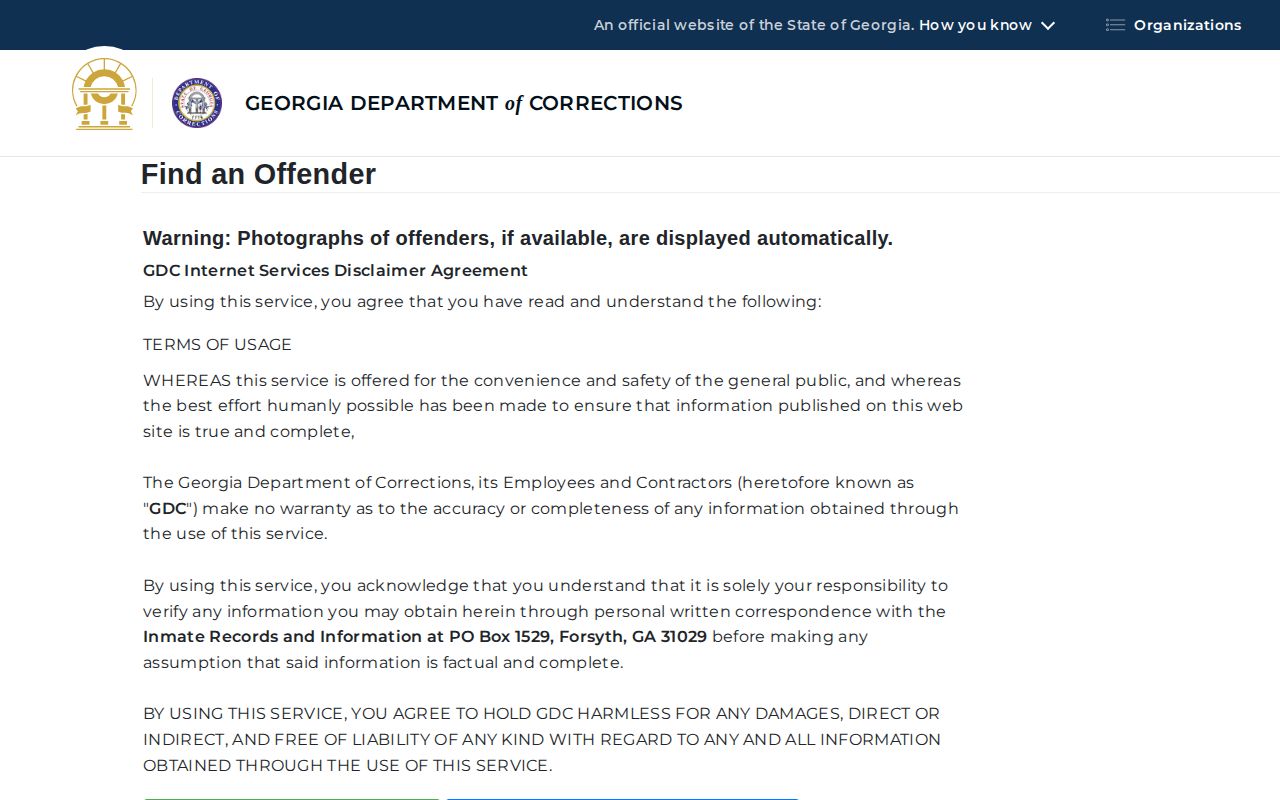
The live result's terminology controls. Eligibility under O.C.G.A. 42-9-45 is not release, and supervision can continue after physical custody ends.
Note: Confirm whether the event was community release, transfer, parole, or discharge before relying on a date-field label.
Union County State Release Fields
A GDC record can combine identity, conviction, sentence, facility, status, and date information. Start with the GDC ID when known because it is more precise than a common name. When it is unknown, narrow the search by county of conviction, age range, offense, gender, race, case number, or most recent institution. County of conviction is not always the same as county of residence.
| Public field | Question it may answer |
|---|---|
| GDC ID | Which state offender record belongs to the person |
| Current status | Whether state custody or another GDC status is reported |
| Most recent institution | Which GDC facility last held the person |
| Sentence begin date | When the recorded state sentence began |
| Maximum release date | The maximum-date concept reported by the system |
| Actual release date | When GDC custody ended if the field appears |
A released or discharged result can remain useful after the person leaves prison. That differs from a current Union County jail roster, where a released person would normally disappear. The GDC record should still be paired with the Union County sentencing docket when the conviction arose locally.
Union County Jail Release Computation
A pretrial detainee has no sentence-based projected date. Bond posting, a court order, dismissal, another hold, or case disposition controls the end of local custody. A sentenced county inmate may have a computed end based on the order, credit for time served, and any lawful jail credit. The precise answer must come from the jail and sentencing court rather than a statewide prison formula.
Ask for the full name, date of birth if known, booking number, approximate booking date, charge, court case number, and the specific date field needed. Useful release-record fields include booking date and time, bond type, hold information, sentence or credit notes, release date and time, release reason, and transfer destination. A narrow request is easier to identify than an open-ended demand for all information about a person.
The sheriff's public current-inmate link has been removed. Its absence prevents an online roster from answering the date question and also means disappearance from the former roster cannot prove release. Direct jail contact, the release record, court docket, and any receiving-agency record form the reliable chain.
Union County Holds and Transfers
Completion of one term may not produce community release. Another Georgia county can have an active hold. GDC may receive a person after a county sentence or felony disposition. Federal agencies can also be involved because Union County Jail accepts arrestees from federal agencies. An immigration detainer can lead to continued custody or transfer rather than release from all restraint.
Union County's quarterly GCATR reports document immigration-status inquiries and some detainer activity, but those reports are aggregate jail reports. They do not identify released people and cannot prove an individual hold. The person's jail record must show whether a detainer or transfer applied to that booking.
When the local record says transfer, locate the receiving system. Search GDC for a state transfer, the BOP locator for federal prison custody, ICE ODLS for immigration detention, or the other county's jail channel for a county transfer. USMS custody may require the federal case or agency contact because there is no broad public USMS release roster comparable to BOP.
Union County Official Date Records
Public search pages do not always expose the document needed. For GDC, the Open Records Unit is the fallback for an official discharge record or transfer detail not available in the offender query. Identify the person by full name, GDC ID if known, birth date if available, facility, conviction county, and the precise record requested.
For local custody, request the booking and release record from the Union County Sheriff's Office. Then obtain the order or docket entry from the correct court. The jail record establishes custody movement, while the court record explains the legal authority. Neither should be replaced by a third-party summary.
When a Union County sentence leads to GDC custody, keep the state and local records together. The Union County docket states the sentence imposed and may show credit awarded by the court. GDC applies its own lawful administrative calculations and reports the date labels available in the offender record. The Parole Board separately controls parole decisions and may report a tentative parole month or maximum release date. These sources can change at different times. A mismatch should prompt a new official check, not an attempt to calculate the date from one field alone.
Projected-date questions should end with a fresh check close to the expected event. Credits, Board action, holds, court changes, and administrative processing can alter what happens. A dated screenshot can document what the system once reported, but the live agency record controls the current official answer at the time of release.